
GRPO 训练教程:GSM8K 与 Geo3K 数据集
本教程介绍如何使用 LightRFT 在两个数学推理数据集上进行 GRPO(Group Relative Policy Optimization)训练:GSM8K(纯文本)和 Geo3K(多模态,含几何图形)。
概述
项目 |
GSM8K |
Geo3K |
|---|---|---|
任务 |
小学数学应用题 |
几何问题求解 |
模态 |
纯文本 |
多模态(文本 + 图像) |
数据来源 |
||
训练集 / 测试集 |
7,473 / 1,319 |
~2,100 / 601 |
奖励机制 |
纯规则奖励(无需神经奖励模型) |
纯规则奖励(无需神经奖励模型) |
基座模型 |
Qwen2.5-0.5B-Instruct(或更大模型) |
Qwen2.5-VL-7B-Instruct |
两个任务均使用纯规则奖励机制:
格式奖励(10%):检查输出是否包含
<think>...</think>推理标签和\boxed{}答案标记。准确率奖励(90%):使用 mathruler 验证最终答案的正确性。
无需额外的神经奖励模型。
1. 数据集预处理
训练前,需要将 HuggingFace 原始数据集转换为 LightRFT 兼容的 parquet 格式。
1.1 GSM8K 预处理
python examples/gsm8k_geo3k/data_preprocess/gsm8k.py \
    --local_save_dir ~/data/gsm8k
脚本执行以下步骤:
从 HuggingFace 加载
openai/gsm8k(也可通过--local_dataset_path指定本地路径)。从每个解答中通过
#### ANSWER模式提取数值答案(去除逗号,如1,000→1000)。将每个问题封装为 chat 结构的 prompt:
{
  "prompt": [
    {"role": "system", "content": "You FIRST think about the reasoning process step by step ... The final answer MUST BE put in \\boxed{} after the reasoning."},
    {"role": "user", "content": "<原始问题>"}
  ],
  "extra_info": {
    "label": "gsm8k_rule",
    "reference": "<提取的数值答案>"
  }
}
将
train.parquet和test.parquet保存到指定目录。
1.2 Geo3K 预处理
python examples/gsm8k_geo3k/data_preprocess/geo3k.py \
    --local_save_dir ~/data/geo3k
脚本执行以下步骤:
从 HuggingFace 加载
hiyouga/geometry3k(也可通过--local_dataset_path指定本地路径)。保留数据集中的几何图形图像。
将每个问题封装为包含图像引用的 chat 结构 prompt:
{
  "prompt": [
    {"role": "system", "content": "You FIRST think about the reasoning process ... The final answer MUST BE put in \\boxed{}."},
    {"role": "user", "content": "<几何问题文本>"}
  ],
  "images": ["<PIL Image>"],
  "extra_info": {
    "label": "geo3k_rule",
    "reference": "<标准答案>"
  }
}
将
train.parquet和test.parquet保存到指定目录。
1.3 输出格式总结
两个预处理脚本产出统一的数据格式:
字段 |
说明 |
|---|---|
|
Chat 结构列表 |
|
PIL 图像列表(仅 Geo3K;GSM8K 无此字段) |
|
|
|
标准答案字符串,用于规则奖励评估 |
2. 训练
2.1 GSM8K — 纯文本 GRPO 训练
# 先编辑脚本中的路径配置,然后执行:
bash examples/gsm8k_geo3k/run_grpo_gsm8k_qwen2.5_0.5b.sh
也可直接使用 torchrun 启动:
torchrun --nnodes 1 --nproc-per-node 8 \
    examples/gsm8k_geo3k/train_colocate.py \
    --pretrain Qwen/Qwen2.5-0.5B-Instruct \
    --prompt_data /path/to/gsm8k_dataset \
    --input_key prompt --label_key label \
    --text_only \
    --loss_agg_mode seq-mean-token-mean \
    --advantage_estimator group_norm \
    --n_samples_per_prompt 5 \
    --num_episodes 30 \
    --max_epochs 1 \
    --train_batch_size 128 \
    --rollout_batch_size 128 \
    --micro_train_batch_size 4 \
    --micro_rollout_batch_size 4 \
    --actor_learning_rate 1e-6 \
    --lr_warmup_ratio 0.03 \
    --init_kl_coef 0.01 \
    --kl_estimator k3 \
    --use_kl_loss \
    --l2 1.0e-2 \
    --fsdp --zero_stage 3 --bf16 \
    --flash_attn --gradient_checkpointing \
    --apply_chat_template \
    --freeze_prefix \
    --adam_offload \
    --rm_use_engine \
    --reward_pretrain "{}" \
    --engine_type sglang --engine_tp_size 2 \
    --engine_mem_util 0.6 --enable_engine_sleep \
    --eval_steps 20 --eval_split test \
    --max_eval_samples 1319 \
    --save_path results/gsm8k_grpo \
    --save_steps 20 --max_ckpt_num 3 \
    --system_prompt 'A conversation between the User and Assistant. The User asks a question, and the Assistant provides a solution. The Assistant first thinks through the reasoning process internally with self-reflection and consistency check and then gives the final analysis and answer. The reasoning process should be enclosed within <think></think>, followed directly by the final thought and answer, the final answer MUST BE put in \\boxed{}, like this: <think> reasoning process here </think> final thought and \\boxed{answer} here.'
2.2 Geo3K — 多模态 GRPO 训练
# 先编辑脚本中的路径配置,然后执行:
bash examples/gsm8k_geo3k/run_grpo_geo3k_qwen2.5_vl_7b.sh
也可直接使用 torchrun 启动:
torchrun --nnodes 1 --nproc-per-node 8 \
    examples/gsm8k_geo3k/train_colocate.py \
    --pretrain Qwen/Qwen2.5-VL-7B-Instruct \
    --prompt_data /path/to/geo3k_dataset \
    --input_key prompt --label_key label \
    --mixed_mm_data \
    --images_key images \
    --loss_agg_mode seq-mean-token-mean \
    --advantage_estimator group_norm \
    --n_samples_per_prompt 8 \
    --num_episodes 20 \
    --max_epochs 1 \
    --train_batch_size 128 \
    --rollout_batch_size 128 \
    --micro_train_batch_size 4 \
    --micro_rollout_batch_size 8 \
    --actor_learning_rate 1e-6 \
    --lr_warmup_ratio 0.03 \
    --init_kl_coef 0.01 \
    --kl_estimator k3 \
    --use_kl_loss \
    --l2 1.0e-2 \
    --fsdp --zero_stage 3 --bf16 \
    --flash_attn --gradient_checkpointing \
    --apply_chat_template \
    --freeze_prefix \
    --adam_offload \
    --rm_use_engine \
    --reward_pretrain "{}" \
    --engine_type sglang --engine_tp_size 2 \
    --engine_mem_util 0.6 --enable_engine_sleep \
    --limit_mm_image_per_prompt 10 \
    --eval_steps 20 --eval_split test \
    --max_eval_samples 700 \
    --save_path results/geo3k_grpo \
    --save_steps 20 --max_ckpt_num 2 \
    --system_prompt 'A conversation between the User and Assistant. The User asks a question, and the Assistant provides a solution. The Assistant first thinks through the reasoning process internally with self-reflection and consistency check and then gives the final analysis and answer. The reasoning process should be enclosed within <think></think>, followed directly by the final thought and answer, the final answer MUST BE put in \\boxed{}, like this: <think> reasoning process here </think> final thought and \\boxed{answer} here.'
2.3 Geo3K — LoRA GRPO 训练(参数高效微调)
在资源受限的环境下,可使用 LoRA 仅微调少量参数:
bash examples/gsm8k_geo3k/run_grpo_geo3k_lora_qwen2.5_vl_7b.sh
LoRA 相关的关键参数:
--lora_rank 128 \
--lora_alpha 256 \
--target_modules all-linear
3. 关键超参数
参数 |
GSM8K 默认值 |
Geo3K 默认值 |
说明 |
|---|---|---|---|
|
5 |
8 |
每个 prompt 的 rollout 采样数(GRPO 组大小) |
|
30 |
20 |
总训练轮数 |
|
128 |
128 |
全局训练批次大小 |
|
128 |
128 |
全局 rollout 批次大小 |
|
4 |
4 |
每张卡的微训练批次大小 |
|
4 |
8 |
每张卡的微 rollout 批次大小 |
|
1e-6 |
1e-6 |
Actor 学习率 |
|
0.03 |
0.03 |
学习率预热比例 |
|
0.01 |
0.01 |
KL 散度惩罚系数 |
|
k3 |
k3 |
KL 估计器类型 |
|
1024 |
1024 |
最大 prompt 长度 |
|
2048 |
2048 |
最大生成长度 |
|
group_norm |
group_norm |
GRPO 优势估计方法 |
|
2 |
2 |
推理引擎张量并行度 |
|
1e-2 |
1e-2 |
L2 正则化权重 |
|
是 |
否 |
纯文本模式(不处理图像) |
|
否 |
是 |
启用多模态数据处理 |
4. 奖励机制
4.1 RECIPE 配置
奖励系统由 examples/gsm8k_geo3k/reward_models_utils.py 中基于标签的 RECIPE 映射驱动:
RECIPE = {
    "geo3k_rule": [("geo3k_rule", None, 1.0)],
    "gsm8k_rule": [("gsm8k_rule", None, 1.0)],
}
每个样本的 label 字段(在预处理阶段设置)决定了应用哪个奖励函数。
4.2 格式奖励(权重 10%)
验证模型输出是否遵循要求的推理格式:
<think> 推理过程 </think> 最终分析和 \boxed{答案}
检查逻辑使用正则表达式验证:
存在
<think>...</think>标签。存在
\boxed{...}标记。</think>闭合标签出现在\boxed{}之前。
def format_reward_fn(sol: str) -> float:
    think_match = re.search(r'<think>.*?</think>', sol, re.DOTALL)
    boxed_match = re.search(r'\\boxed\{.*?\}', sol, re.DOTALL)
    if think_match and boxed_match:
        return 1.0 if think_match.end() <= boxed_match.start() else 0.0
    return 0.0
4.3 准确率奖励(权重 90%)
从 \boxed{} 中提取答案并与标准答案比对:
def accuracy_reward_fn(sol: str, gt: str) -> float:
    from mathruler.grader import extract_boxed_content, grade_answer
    pred = extract_boxed_content(sol)
    return 1.0 if grade_answer(pred, gt) else 0.0
mathruler.grader 处理数值等价、分数化简等数学归一化。
4.4 综合奖励
final_reward = 0.9 * accuracy_reward + 0.1 * format_reward
4.5 响应提取
在计算奖励前,会从完整的对话文本中提取 assistant 的回复,避免系统提示中的示例导致误判:
def extract_response(text: str) -> str:
    # 查找最后一个 <|im_start|>assistant ... <|im_end|> 片段
    ...
5. 训练监控(W&B)
5.1 启用 W&B 日志
在训练脚本中设置以下环境变量:
export WANDB_API_KEY="your_api_key"
export WANDB_PROJECT="LightRFT-Experiments"
export WANDB_MODE="online"  # "offline" 表示仅本地记录
5.2 关键指标
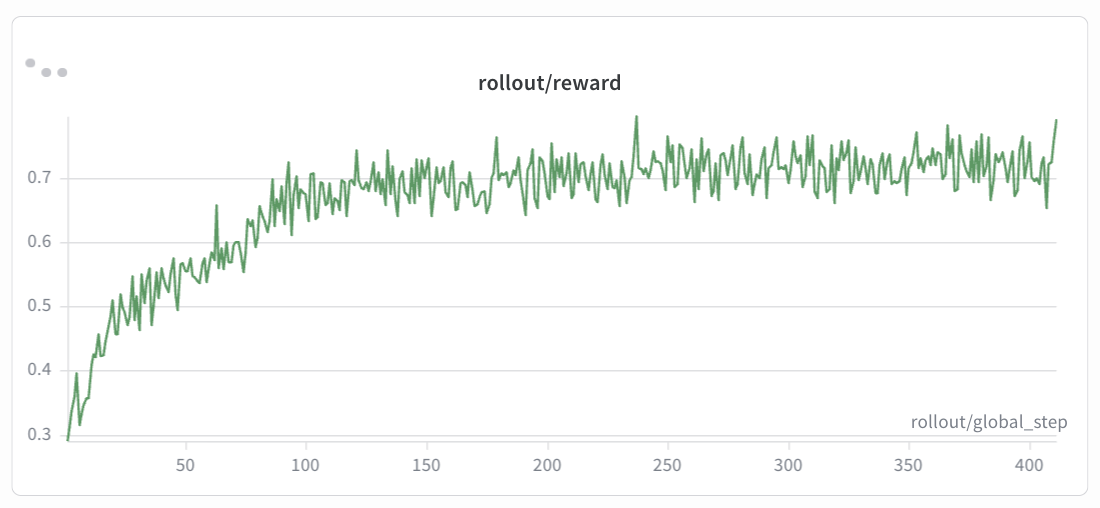
rollout/reward
GSM8K (Qwen2.5-0.5B-Instruct):
Geo3K (Qwen2.5-VL-7B-Instruct):
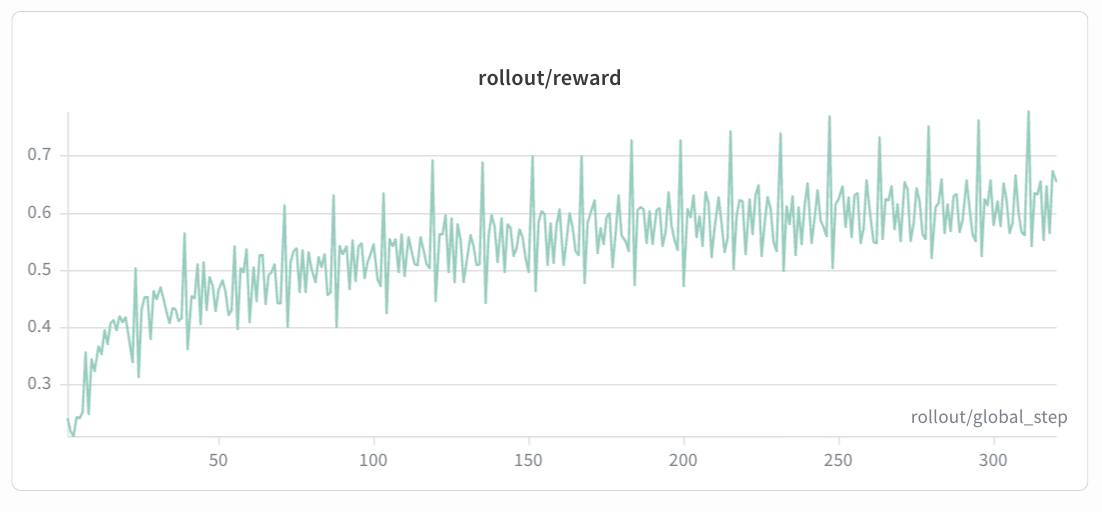
预期走势:rollout/reward 曲线应随训练步数呈现稳定上升趋势。在训练初期,奖励通常较低,因为模型尚未学会正确的格式和推理模式。随着训练推进,奖励应逐步平滑、单调递增,伴有轻微波动,并最终趋于稳定。若奖励过早停滞或急剧下降,建议调整 KL 系数或学习率。
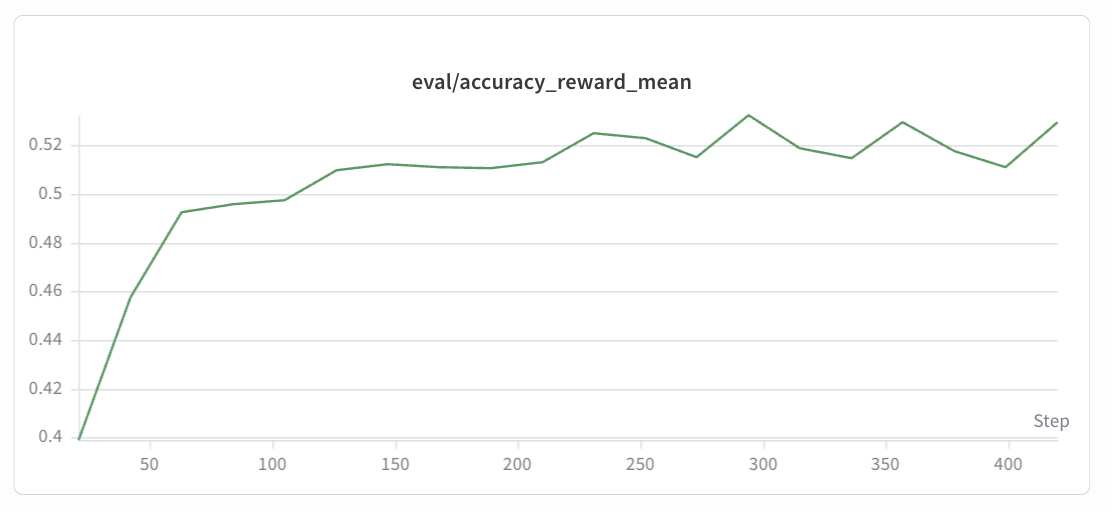
eval/accuracy
GSM8K (Qwen2.5-0.5B-Instruct):
Geo3K (Qwen2.5-VL-7B-Instruct):
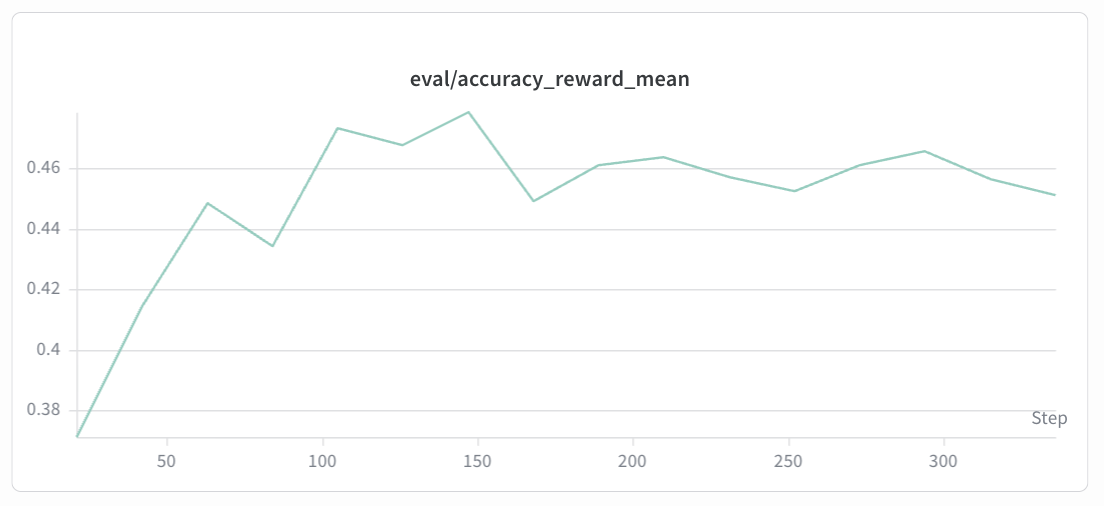
预期走势:eval/accuracy 曲线反映模型在测试集上的实际解题能力,应与奖励曲线正相关但可能略有滞后。准确率预计从基座模型的初始水平逐步提升,整体呈上升趋势并最终趋于收敛。由于评估样本量较小,eval 曲线的波动会比 reward 曲线更大。若出现突然下降,可能表明过拟合或 KL 散度问题,建议适当调整 KL 系数或学习率。
5.3 其他有用指标
指标 |
说明 |
|---|---|
|
格式合规率 |
|
答案正确率 |
|
Actor 策略损失(应逐步下降) |
|
与参考策略的 KL 散度(应保持有界) |
|
策略熵(逐步下降表明模型在学习) |
6. 常见问题与建议
OOM(显存不足):减小
micro_train_batch_size/micro_rollout_batch_size,或降低--engine_mem_util。收敛缓慢:增大
--n_samples_per_prompt以获得更好的 GRPO 优势估计。格式奖励始终为 0:检查
--system_prompt和--apply_chat_template是否正确传入。Geo3K 图像加载错误:确保预处理后的 parquet 文件包含有效的 PIL 图像对象,且设置了
--images_key images。LoRA 训练:使用
--lora_rank 128 --lora_alpha 256在效率和模型容量之间取得良好平衡。